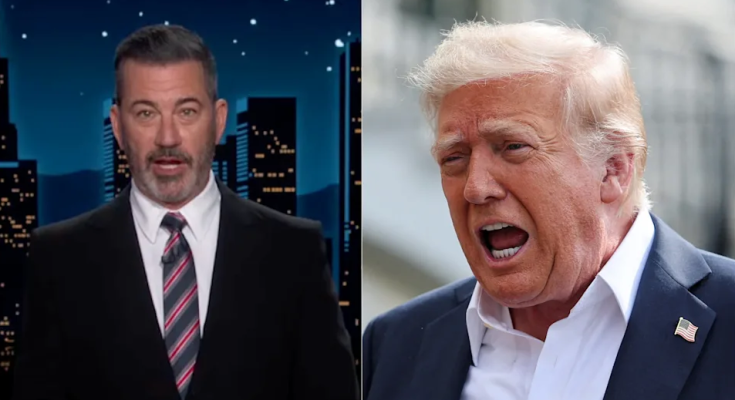
Jimmy Kimmel stepped onto his Hollywood studio stage tonight, launching into a devastating monologue featuring a brutal new viral video that thoroughly humiliated Donald Trump before millions of television viewers.
The late-night comedian displayed high-definition video clips on a massive backdrop screen, hilariously pointing out absurd contradictions between official campaign speeches and recent unscripted public appearances online today.
Kimmel systematically analyzed the viral video frame by frame, delivering razor-sharp, sarcastic punchlines that weaponized the embarrassing footage into an undeniable, hilarious critique of the former president’s campaign.
The studio audience erupted into continuous, roaring laughter as Kimmel highlighted the most awkward moments, creating a masterful television segment that immediately captured the entire internet’s rapt attention tonight.
Watching the live broadcast from his Mar-a-Lago resort, Donald Trump reportedly flew into an immediate rage, screaming at television monitors while demanding his legal team take action against the network.
Aides described a chaotic scene inside the Florida estate as the former president clutched his smartphone, furiously insisting that senior campaign advisors issue a fierce public statement defending his reputation.
Ignoring cautions from legal counsel and communications staff, Trump launched an angry midnight tirade on Truth Social, releasing multiple all-capital posts attacking Jimmy Kimmel’s comedic broadcast segment online today.
He slammed Kimmel as a low-rated, untalented performer, claiming the viral video breakdown was a dishonest, politically motivated hit job designed to sabotage his presidential campaign during peak national election season.
However, Trump’s explosive online outburst backfired spectacularly, drawing unprecedented public attention to the brutal video and causing clips of Kimmel’s monologue to go wildly viral across all digital platforms.
Millions of curious internet users who had missed the initial broadcast rushed online to watch the segment, searching for the exact video clips and punchlines that had provoked such anger.
By early morning, video excerpts of Kimmel’s monologue topped global trending feeds across TikTok, X, and YouTube, amassing tens of millions of views and generating thousands of opinionated user comments.
Senior campaign strategists held emergency conference calls at dawn, frantically debating how to manage the growing public relations storm while attempting to pivot national media focus back toward policy platforms.
Advisors pleaded with the candidate to stop commenting on the late-night show, warning that continuing the public feud would only prolong the embarrassing news cycle across major national news networks.
Despite these urgent internal warnings, Trump continued attacking late-night performers during phone interviews with conservative radio hosts throughout the afternoon, calling the comedic breakdown unfair, dishonest, and completely illegal.
He argued that broadcast networks operating on public airwaves should face strict regulatory scrutiny for airing biased satirical content, asserting that equal time regulations ought to apply during national election seasons.
Legal scholars quickly dismissed those claims on air, pointing out that satirical commentary targeting public officials is fully protected under bedrock First Amendment free speech guarantees in federal court precedent.
Experts noted that public figures cannot suppress parody or satire simply because it causes personal embarrassment or highlights organizational instability during high-stakes national political campaigns in America today nationwide.
Rival political action committees capitalized on the viral moment immediately, purchasing targeted digital ad slots across battleground states featuring excerpts from Kimmel’s monologue alongside reports analyzing campaign messaging consistency.
These targeted political advertisements performed exceptionally well among undecided suburban voters, who viewed the constant communications friction as evidence of administrative instability and poor executive oversight within top leadership today.
On cable news channels, political pundits dissected the feud line by line, debating whether late-night comedy hosts held more cultural influence over swing voters than traditional political reporting and formal press.
Analysts noted that satire combines visual archival evidence with sharp humor, making complex political debates far more engaging and memorable for younger citizens who rarely watch full-length formal news broadcasts today.
Focus groups conducted in key battleground counties revealed that swing voters found Kimmel’s comedic breakdown highly entertaining, while expressing frustration over the candidate’s persistent online feuds with television entertainers.
Undecided voters noted that while they expected politicians to handle harsh media criticism, organizational stability and focus on pressing national issues were essential qualities for anyone seeking high executive office today.
Meanwhile, Jimmy Kimmel returned to his Hollywood studio stage the following evening, gleefully thanking Trump for providing free promotion and boosting his show’s viewership ratings to seasonal record levels on TV.
“I want to thank Donald Trump for making our monologue the most-watched video in the country again,” Kimmel joked, holding up printouts of the angry late-night Truth Social posts on air.
The host proceeded to review the campaign’s defensive statements regarding the viral video, turning their excuses into fresh punchlines that generated another massive wave of viral engagement across global digital media.
The second broadcast cemented Kimmel’s reputation as one of the most formidable comedic voices in contemporary late-night political television, demonstrating the enduring power and cultural influence of satire in public life.
Representatives for the campaign released a brief statement dismissing the segment as a desperate ratings stunt by struggling entertainers who rely on personal attacks rather than substantive political reporting today.
However, sources close to the campaign revealed that senior officials were quietly frustrated by the ongoing public spectacle, preferring to avoid distractions that draw unwanted media focus to internal staff dynamics.
They urged the candidate to ignore late-night comedy bits entirely, recognizing that engaging in public spats with television hosts only elevated their cultural profile and validated their satirical commentary on air.
Trump’s aggressive reaction instead transformed a single evening monologue into a major multi-day news story, dominating political talk shows, morning opinion panels, and digital news columns across the entire country today.
Media study programs at major universities began analyzing the feud as a classic case study in narrative control, digital virality, and the influence of late-night television comedy on contemporary political discourse.
Professors noted that an inability to ignore comedic mockery ultimately amplifies the critic’s message, proving that emotional reactions from public figures often do far more damage than initial comedy bits.
The episode demonstrated that in the modern digital media era, attempts to attack or suppress comedy bits almost always trigger the Streisand effect, driving millions of curious extra viewers online globally.
Late-night hosts across other major networks joined in the commentary, incorporating references to Kimmel’s video into their own monologues, creating a unified comedic front across major broadcast television networks tonight.
Comedians highlighted the dramatic contrast between polished campaign messaging and the chaotic reality of unscripted personal feuds, delivering sharp observations that resonated deeply with viewers across the entire nation watching live.
At a massive campaign rally later that week, Trump spent considerable time complaining about late-night television hosts, departing entirely from his prepared teleprompter speech notes on stage before thousands of supporters.
“These fake comedians have zero talent and say terrible, dishonest things about our hardworking campaign team,” Trump shouted into the microphone as the crowd cheered loudly in solidarity with his message today.
While loyal supporters cheered enthusiastically, campaign advisors standing backstage winced as the candidate spent valuable broadcast time addressing personal grievances instead of pressing policy issues facing American voters today nationwide.
The rally footage provided fresh material for late-night comedy writers, creating a self-sustaining feedback loop where complaints fueled even more hilarious television comedy bits the following week across networks.
Kimmel aired clips from the rally breakdown on his next show, offering a humorous breakdown of the speech while inviting the former president to appear live on his show anytime in person.
“Donald, if you think our coverage is unfair, come on the show and set the record straight live on air,” Kimmel said directly to the camera, sparking widespread online chatter nationwide.
Though an appearance was highly unlikely, the bold invitation highlighted the vulnerability facing political figures whose past statements and public appearances remain permanently preserved in digital archives accessible to media.
Cultural commentators observed that satire often succeeds where formal journalism stumbles, using sharp humor to highlight systemic hypocrisies that solemn news reports fail to convey effectively to general television audiences.
By turning the spotlight on the brutal video, Kimmel exposed a vulnerable spot in the candidate’s campaign armor, demonstrating the lasting power of comedy in contemporary political discourse today.
The fallout from the segment rippled across the political landscape for weeks, illustrating how modern late-night television can still shape public discourse and influence major national election campaign narratives everywhere.
Communication experts noted that candidates who react angrily to television satire often inadvertently amplify their critic’s message, driving curiosity and increasing video views among previously disinterested audience segments nationwide.
In contrast, political figures who handle satirical criticism with good-humored composure can neutralize potential damage, demonstrating the emotional maturity and steady temperament that swing voters value in executive leadership.
Rival campaign strategists capitalized on the ongoing public discussion, launching digital media drives that emphasized the importance of executive stability, character, and steady leadership in managing national governance responsibilities.
These digital campaigns reached millions of voters, keeping the late-night feud relevant in key swing states where voters weighed character and governance style heavily when deciding their final choices today.
Meanwhile, media analytics firms noted that the organic reach of viral comedy clips far outweighed the impact of paid television advertisements, giving late-night hosts immense indirect influence over public opinion.
A single viral comedy clip could achieve tens of millions of views organically, achieving higher engagement metrics than multi-million-dollar political action committee ad buys on local television stations across battleground states.
This reality forced political communications teams to rethink their media strategies, realizing that traditional damage control methods were often ineffective against swift, humor-driven viral trends on social media platforms.
As the election season advanced toward its final decisive stretch, the viral clash between late-night comedy and political power stood out as an unforgettable moment of pure media drama today.
It served as an enduring reminder that in democratic societies, public figures remain subject to humor, parody, and critical examination, regardless of their status, wealth, or high political ambition.
Kimmel’s sharp delivery and fearless approach proved that political satire remains a vital tool for holding powerful leaders accountable to truth, consistency, and fairness in public life across America today.
For Donald Trump, the incident was a stark reminder that running for public office exposes every aspect of one’s team and organizational management to intense public scrutiny from global media outlets.
No amount of angry social media posts or aggressive rally speeches could erase the comedic commentary that had already captured the imagination of millions of television viewers nationwide and worldwide today.
In newsrooms across the country, journalists noted that the intersection of pop culture, late-night entertainment, and presidential politics had reached a peak, defining the tone of modern political campaign coverage.
Voters across the political spectrum shared clips, left comments, and debated the implications, making it clear that pop culture commentary played a central role in shaping perceptions throughout the election season.
Kimmel concluded his week of broadcasts by reminding viewers that humor is an essential part of democratic tradition, allowing citizens to process complex political realities through shared national laughter today.
The studio lights dimmed as the closing theme music played, leaving viewers with a memorable display of political satire that resonated long after the broadcast concluded on television screens everywhere tonight.
In the end, Kimmel’s brutal video takedown proved that when political operations operate in chaos, humor stands ready to reveal the unvarnished truth to citizens everywhere in an instant.
As history records these dramatic events, the viral encounter between political power and late-night satire will be remembered as a defining chapter in modern American political communications and entertainment.
The enduring lesson remains clear to all: true political strength comes from authenticity and steady composure, qualities that withstand both sharp comedic satire and rigorous public examination in open society.