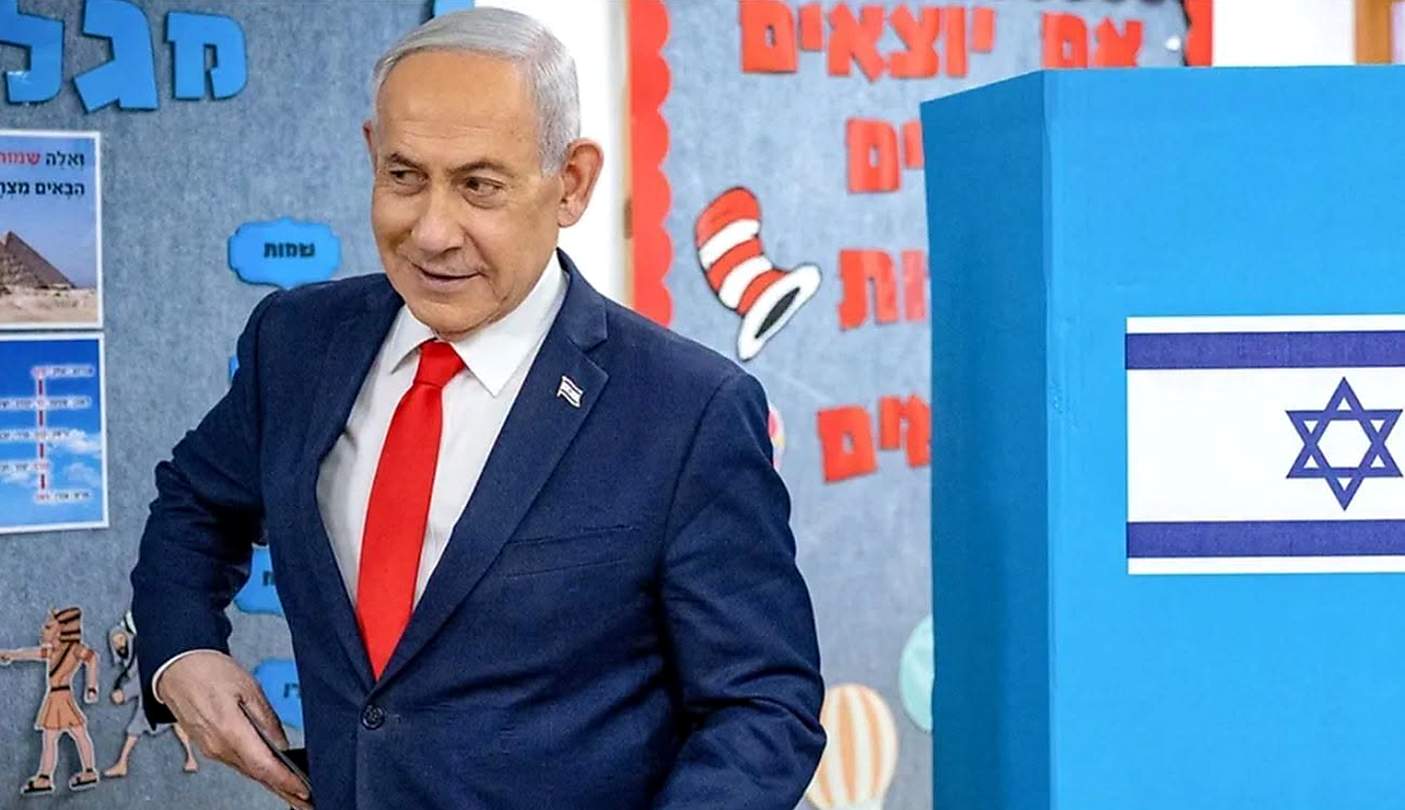
Benjamin Netanyahu’s bloc led Israel’s partial election count Wednesday with 54 projected seats, but remained seven short of a majority.
With 76.8 percent of ballot boxes counted, Gadi Eisenkot’s bloc stood at 47 seats, while Arab-led parties held 19.
Those figures, available before 5:36 a.m. EDT, left the country facing coalition bargaining rather than a confirmed winner.
The latest numbers superseded earlier projections giving Netanyahu’s camp 56 seats and overnight exit polls suggesting a much closer contest.
The central question remained whether either leader could assemble support from at least 61 members of the 120-seat Knesset.
Netanyahu retained a lead over his rival’s bloc, giving supporters reason to resist premature declarations that his career was finished.
However, leading the count does not itself guarantee the ability to form Israel’s government, particularly with competing parties resisting cooperation.
The Jerusalem Post reported at 11:20 a.m. Israeli time that more than four million votes had been counted.
Its update also put Netanyahu’s bloc at 54 seats and the opposition grouping at 47, consistent with the partial tally.
The election attracted unusually high participation, with the Central Elections Committee reporting turnout of 77.7 percent when polling stations closed.
That was 7.1 percentage points above the 2022 election, according to the Jerusalem Post’s live coverage.
Military participation was also high, with nearly 80 percent of Israeli troops voting, according to the military’s announcement.
President Donald Trump welcomed Netanyahu’s performance and credited his own endorsement with helping reverse expectations about the Israeli leader’s prospects.
Trump characterized the result as a comeback that could yield a stalemate or victory, while counting was still underway.
That assessment represented the president’s interpretation of the campaign, rather than independent proof that his endorsement determined voters’ choices.
Netanyahu himself called for a strong government of the right during an appearance before supporters in Jerusalem early Wednesday.
He urged Jewish and Zionist political forces to unite, signaling that coalition negotiations would be central to the next phase.
His rival, former military chief Eisenkot, also pledged to form a government despite falling short of a majority.
AFP reported that Eisenkot had campaigned against governing with Israeli Arab lawmakers, a position complicating potential alternatives to Netanyahu.
Arab parties could nevertheless provide parliamentary support to a minority administration without formally joining its coalition, according to AFP.
Such arrangements would require political agreements, and the available results did not establish that any agreement had been reached.
AFP also noted that failed negotiations could raise the possibility of another election, extending the country’s political uncertainty.
In the meantime, Netanyahu would remain caretaker prime minister until a new government took office, preserving his immediate position.
That distinction matters for American audiences: an inconclusive parliamentary election does not automatically remove the incumbent from office.
Earlier exit polls had shown the two main blocs level, demonstrating why surveys should not be mistaken for final results.
Reuters’ election graphics showed two television exit polls allocating 51 seats each to Netanyahu’s bloc and the opposition grouping.
A third television projection placed Netanyahu’s camp at 52 and its opponents at 49, with unaligned parties holding the balance.
One important outstanding category involved ballots cast through the double-envelope system, including votes from soldiers and other eligible absentee voters.
The Times of Israel reported estimates of approximately 600,000 double envelopes, with their complete count potentially taking until Friday.
Those ballots also include votes from prisoners, medical personnel, people with medical conditions, and Israeli representatives serving abroad.
The publication cautioned that the large number of reservists made this year’s political impact harder to predict.
Meanwhile, opposition politician Yair Golan urged cooperation with Arab parties, highlighting the unresolved divisions over a potential governing alliance, the BBC reported.
The Associated Press reported that President Isaac Herzog would select the candidate considered best positioned to form a government.