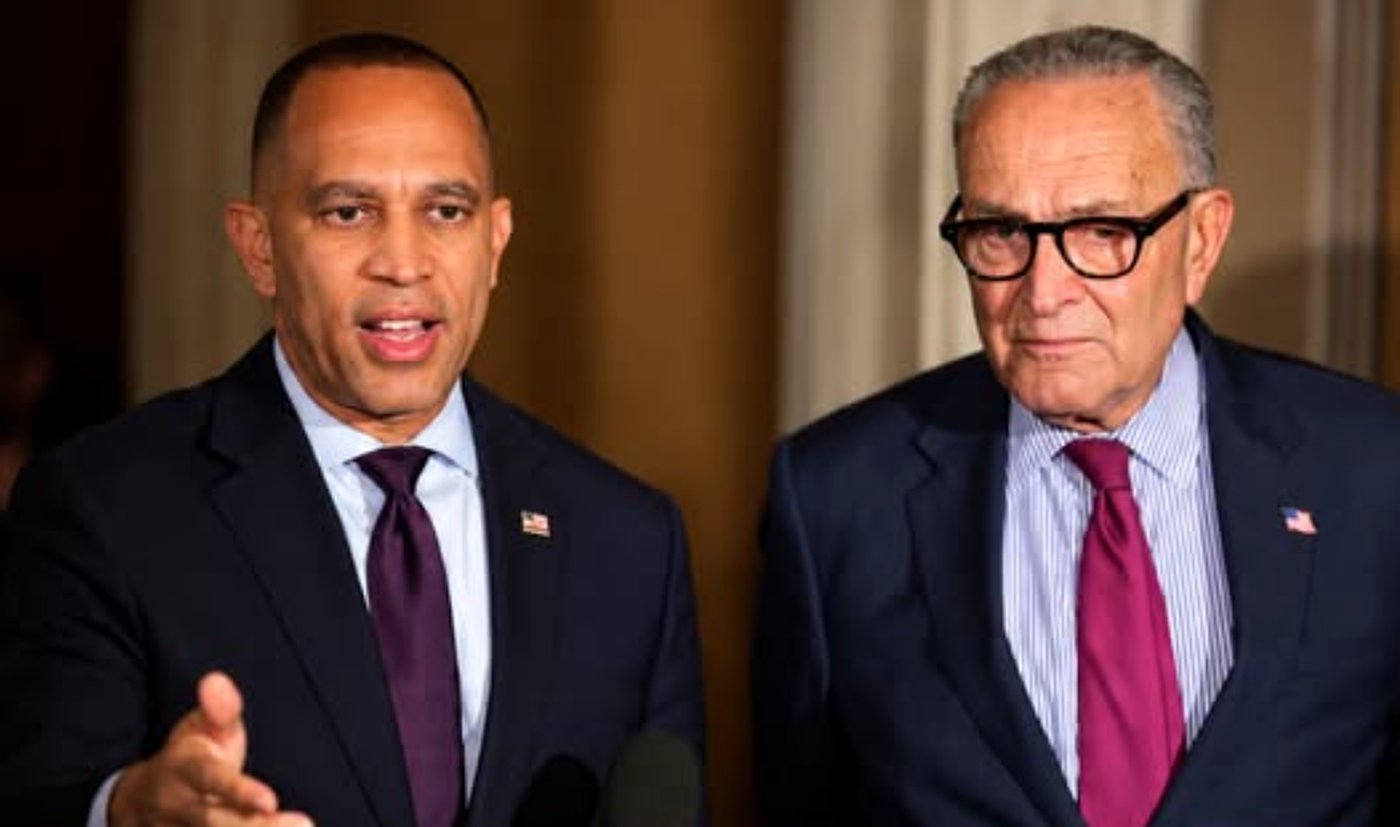
House Minority Leader Hakeem Jeffries issued his first statement after Democrats blew out Republicans to take control of the chamber, setting him up to become Speaker in January.
Democrats have won control of the House of Representatives, ending Republican control and dramatically changing the balance of power in Washington.
NBC News projected the Democratic victory after the party captured enough Republican-held districts to surpass the 218 seats required for a majority.
Jeffries told NBC News’ “Meet the Press” that Democrats “haven’t ruled anything in and we haven’t ruled anything out” on potentially impeaching President Trump for what would be a third time.
“I wouldn’t characterize it as investigating them like crazy. We’re going to follow the facts, apply the law, be guided by the Constitution, and let the chips fall where they may,” Jeffries told reporters at Democrats’ campaign headquarters before the election.
The House takeover came with an even broader Democratic performance Tuesday, as the party also won control of the Senate.
Democrats are positioned to enter January with what NBC News said could become their largest House majority in nearly two decades.
Several races remained unresolved Wednesday, so the Democratic majority could keep growing as additional ballots are counted.
The result ends two years of unified Republican government and creates divided government for the final half of President Donald Trump’s second term.
Republicans entered the election with only a narrow House majority, leaving Democrats needing relatively modest gains to take control.
Instead, Democrats accumulated victories across battleground districts while also making gains in areas that had recently favored Republicans.
NBC News reported that voter frustration with Trump, affordability, corruption, and insufficient congressional oversight contributed to the Democratic gains.
Forty-three percent of voters surveyed in NBC News’ exit poll said expressing opposition to Trump was one reason for their vote.
Another 71% said Congress had not provided enough oversight of Trump, including 41% of Republican voters surveyed.
AP polling similarly found widespread concern about living costs and the direction of the country as voters delivered major Democratic gains.
The House result immediately elevates Democratic Leader Hakeem Jeffries, who is positioned to become speaker when the new Congress convenes January 3.
Democratic control will give Jeffries and his caucus authority over committees, hearings, subpoenas and which legislation receives consideration on the House floor.
House Democrats have already signaled plans for aggressive investigations of the Trump administration after two years of Republican control.
California Rep. Robert Garcia, the ranking Democrat on the House Oversight Committee, summarized the coming approach with a terse warning for Trump: “Lawyer up.”
Democrats are also promising an opening legislative agenda focused heavily on affordability, including gasoline, groceries and health care, all issues they literally ignored during Joe Biden’s four-year disaster of a presidency.
Meanwhile, Trump has already indicated he is prepared to use his veto authority extensively if Democrats send him legislation he opposes.
The president has jokingly described the possibility of becoming “Mr. Veto,” although he has also indicated he remains open to negotiating with Democrats.
“I don’t want to be just sitting there for two years vetoing everything,” Trump said following the election.
Overriding a presidential veto requires two-thirds support in both chambers, a threshold Democrats will not possess on their own.
The House takeover nevertheless gives Democrats substantial power to block Trump-backed legislation and prevent Republicans from advancing another party-line package through Congress.
Republicans also face an internal reckoning after losing the majority, with questions emerging about Speaker Mike Johnson’s future in House leadership.
Johnson acknowledged before Election Day that Republicans faced difficult historical headwinds because the president’s party traditionally loses House seats during midterms.
Those losses ultimately proved large enough not merely to erase the Republican majority but to give Democrats significant breathing room.
Republicans still control Congress through the remainder of 2026, creating a potentially consequential lame-duck session before Democrats assume power in January.
Lawmakers face unfinished government-funding business, while Republicans have only weeks remaining to advance priorities requiring congressional approval.