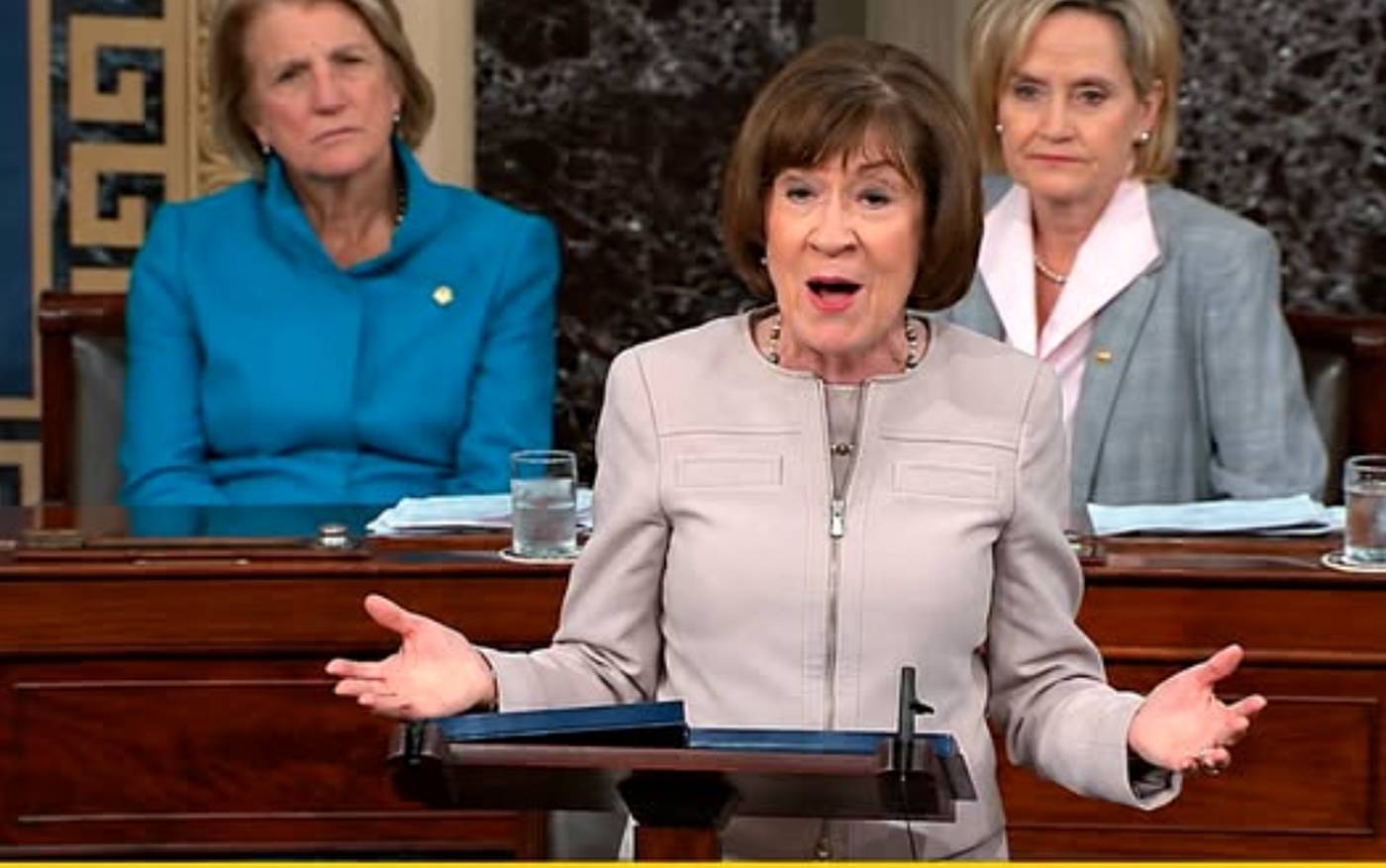
Maine Republican Sen. Susan Collins broke with Senate Republican leadership this week and voted with Democrats on a key vote.
Collins voted with liberals on a Democratic-backed motion to send the Senate’s $70 billion budget reconciliation package back to committee for further review.
The procedural motion, offered by Sen. Jon Ossoff (D-Ga.), sought to recommit the legislation to the Senate Judiciary Committee to investigate allegations that insurance companies have improperly denied medical treatment and coverage to patients.
Collins’ vote placed her at odds with most Senate Republicans, who opposed delaying the legislation and argued that the reconciliation package should continue moving through the legislative process without additional committee review.
The motion failed 47-50.
“Let’s ban insurance companies from denying or delaying medically necessary healthcare to Americans,” Ossoff said on the Senate floor when introducing his amendment.
He shared with fellow senators the challenges faced by a constituent diagnosed with multiple myeloma, a rare blood cancer, who struggled to get her medical care covered by her insurance company.
“Across America, insurance companies continue to deny and delay medically necessary healthcare,” Ossoff added.
Ossoff’s motion was similar to one he proposed during the Senate budget resolution in April, which aimed to create a point of order against any budget reconciliation bill that did not address insurance companies delaying or denying medical care, said the outlet.
Collins joined two other Republicans—Sen. Dan Sullivan (R-Alaska) and Sen. Josh Hawley (R-Mo.)—in supporting Ossoff’s amendment in April.
But Sullivan and Hawley both voted against the amendment.
If Ossoff’s motion had passed, it would have annihilated the budget reconciliation bill, which would provide funding for Immigration and Customs Enforcement and Border Patrol through 2029 if signed into law by President Trump.
This comes as Collins lost her re-election earlier this month to Democrat Troy Jackson.
Collins conceded the race, bringing an end to a Senate career that began with her first election in 1996.
She was seeking a sixth term and served as Maine’s longest-tenured member of Congress, with nearly three decades in Washington.
“It has been the honor of my life to serve the people of Maine in the United States Senate.”
Collins also said she had called Jackson to congratulate him and promised her staff would help ensure a smooth transition.
Her departure costs Republicans the chair of the Senate Appropriations Committee, one of the chamber’s influential positions overseeing federal spending.
Collins had argued that her seniority and committee leadership gave Maine an advantage in securing resources and advancing priorities.
Jackson, a fifth-generation logger and former Maine Senate president, campaigned as a working-class Democrat with close ties to organized labor.
“Maine, I owe you everything,” Jackson wrote on X after the projected victory.
He promised to remember his roots and those he intended to represent as he prepared to move into the Senate.
The Democrat previously represented parts of Aroostook County in the Legislature, building an identity connected to rural communities and workers.
His path to November was turbulent, beginning with his replacement of Democratic nominee Graham Platner on the ballot.
Platner withdrew in July amid sexual-assault allegations, prompting a Maine Democratic Party vote that installed Jackson as the replacement nominee.
That substitution gave Democrats a former legislative leader after the collapse of their original nominee’s campaign threatened their Senate opportunity.
Jackson then faced personal controversy when reports said his partner, the mother of his children, was also his second cousin.
According to those reports, the couple share great-grandparents, a revelation that became an obstacle during the Democrat’s compressed campaign.
Despite that controversy, Jackson defeated a Republican who had repeatedly survived in a state increasingly favorable to Democratic presidential candidates.