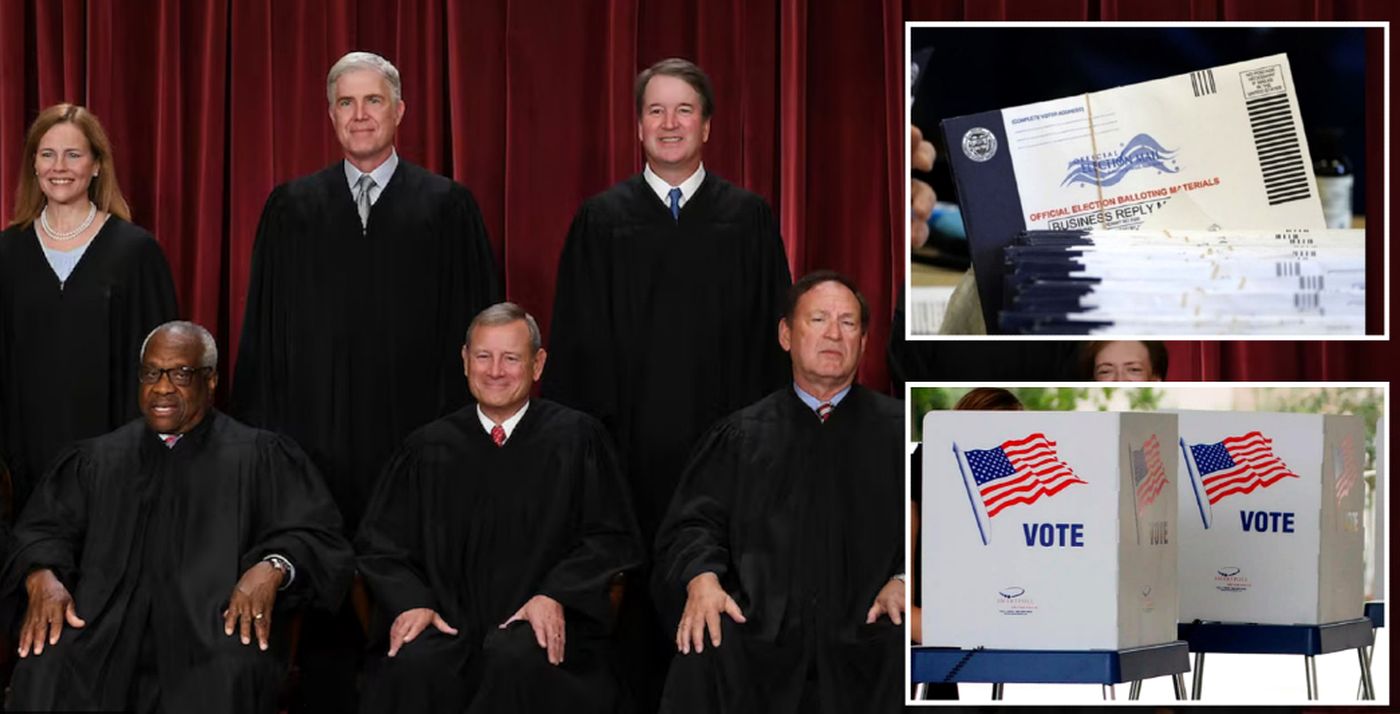
Alabama Republicans are taking their congressional redistricting fight back to the Supreme Court after a federal court blocked the state’s GOP-backed map.
The federal court ruled this week that Republicans intentionally discriminated against Black voters despite the Supreme Court’s recent decision weakening the Voting Rights Act.
On Wednesday, Alabama officials filed an emergency appeal asking the nation’s highest court to allow the state to use a Republican-favored congressional map for the 2026 elections.
Control for the U.S. House could come down to just a handful of seats.
So, Alabama being able to shift even one seat to Republicans is a big deal.
The filing came just one day after a three-judge federal panel ruled Alabama could not move forward with the map and instead must continue using a court-ordered district configuration that helped Democrats gain an additional congressional seat.
The latest legal battle has quickly become one of the biggest tests yet of the Supreme Court’s recent ruling in Louisiana v. Callais, which significantly narrowed the use of race in congressional redistricting and triggered a wave of Republican-led map redraws across the South.
Alabama Republicans argue the Supreme Court’s ruling vindicates their position and clears the way for the state to abandon a map containing two majority-Black districts. But the lower federal court said the issue in Alabama goes beyond the Voting Rights Act alone.
In Tuesday’s ruling, the panel concluded the Alabama map still reflected unconstitutional racial discrimination.
“Ultimately, we cannot see our way clear to requiring Alabamians to cast their votes in the 2026 elections under a districting plan tainted by intentional race-based discrimination,” the judges wrote.
The court added that maintaining the current court-approved map would not disrupt upcoming elections.
The panel included U.S. Circuit Judge Stanley Marcus, appointed by former President Bill Clinton, along with District Judges Anna Manasco and Terry Moorer, both appointed by President Donald Trump.
Their ruling forces Alabama to continue using the court-drawn congressional map first implemented during the 2024 election cycle. That map created a second district with a substantial Black voting population and ultimately paved the way for Democratic Rep. Shomari Figures to win office.
Alabama Attorney General Steve Marshall blasted the decision and vowed to continue fighting.
“This is a very fluid situation, and I will do my best to keep the people of Alabama apprised of our efforts,” Marshall said. “Know this—in my mind, it is not a matter of whether we win this case, only when.”
The legal fight over Alabama’s congressional map has stretched on for years and has become one of the central battlegrounds in the broader national debate over race, redistricting, and political power.
In 2023, federal courts ruled Alabama’s original Republican-drawn map likely violated the Voting Rights Act because it included only one majority-Black district in a state where roughly 27 percent of residents are Black. Courts ordered Alabama to create a second district where Black voters would have an opportunity to elect their preferred candidates.
Republicans resisted those rulings at the time, arguing they were being forced to engage in unconstitutional racial gerrymandering.
After the Supreme Court’s recent Louisiana v. Callais decision weakened longstanding Voting Rights Act standards involving race-based districts, Alabama Republicans moved quickly to revive their preferred map. The Supreme Court previously agreed to let lower courts reconsider the Alabama case in light of the Louisiana ruling.
But after reviewing the matter again, the three-judge panel concluded its earlier findings about intentional racial discrimination remained valid regardless of the Supreme Court’s new guidance on the Voting Rights Act.
The judges said there was still “undisputed evidence” that the map intentionally diluted Black voting strength.
Now the issue is once again headed toward the Supreme Court, where justices may soon decide how far states can go in eliminating race-conscious districts following the Court’s recent ruling.