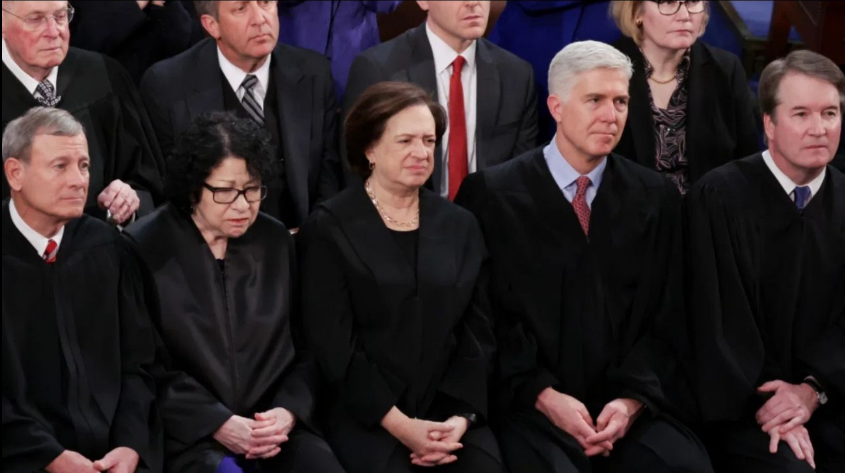
The Supreme Court on Tuesday ruled that Colorado’s ban on conversion therapy for minors violates the First Amendment rights of a therapist who challenged the law. In an 8–1 decision, the court sided with Kaley Chiles, a conservative Christian therapist, finding that the restriction on counseling practices amounted to a violation of free speech protections
The Supreme Court on Tuesday ruled that Colorado’s ban on conversion therapy for minors violates
The Supreme Court on Tuesday ruled that Colorado’s ban on conversion therapy for minors violates the First Amendment rights of a therapist who challenged the law. In an 8–1 decision, the court sided with Kaley Chiles, a conservative Christian therapist, finding that the restriction on counseling practices amounted to a violation of free speech protections.
The ruling is expected to have broader national implications, as more than 20 states have enacted similar laws. Legal analysts also say the decision could affect other areas of regulation involving professional speech in medical and counseling settings.
Writing for the majority, Justice Neil Gorsuch said that “the First Amendment stands as a shield against any effort to enforce orthodoxy in thought or speech in this country.”
In its decision, the high court accepted Chiles’ argument that Colorado’s ban on conversion therapy regulates speech rather than conduct, rejecting the state’s position that the law governed professional practices.
The court concluded that the measure differs from typical health care regulations, which are generally focused on conduct, not speech. The case will now return to lower courts for further proceedings consistent with the ruling.
Colorado’s law “does not just ban physical interventions,” Gorsuch wrote. It also “censors speech based on viewpoint.”
She emphasized the distinction between speech and conduct
Left-wing Justice Ketanji Brown Jackson was the only dissenter and took the unusual step of reading a summary of her opinion in the courtroom. She emphasized the distinction between speech and conduct. “Under our precedents, bedrock First Amendment principles have far less salience when the speakers are medical professionals,” Jackson claimed.
🔥🚨BREAKING: U.S. Supreme Court RULES AGAINST Colorado’s radical ban on GENDER conversion therapy for minors — a major victory for parental rights and free speech.
It was an 8-1 decision; Justice Ketanji Brown Jackson was the lone dissenter.
The ruling protects counselors who… pic.twitter.com/n6ETSDioI6
— The Patriot Oasis™ (@ThePatriotOasis) March 31, 2026
https://twitter.com/ThePatriotOasis/status/2038984982077579737
Conversion therapy is a practice supported by some religious conservatives that seeks to encourage minors to identify with a sexual orientation or gender identity consistent with heterosexual or birth-assigned norms. Colorado law prohibits licensed therapists from engaging in the practice, though the restriction does not apply to religious organizations or family members.
The ruling likely will impact other forms of medical regulation, with Jackson saying the court could be “ushering in an era of unprofessional and unsafe medical care” where some forms of treatment are effectively free from regulation. She cited informed consent requirements—rules that ensure patients are fully aware of potential risks before undergoing treatment—as an example of regulations that could be affected.
Most major medical organizations are opposed to conversion therapy and claim that research has found it to be ineffective. But many, if not all, of those same organizations have long been coopted by left-wing political thought over basic scientific facts. The American Medical Association, one of the country’s top medical organizations, even goes to far as to support the absurd notion that there are more than two genders.
Meanwhile, the U.S. Department of Justice asked the Supreme Court to allow the administration to move forward with ending temporary deportation protections for more than 350,000 Haitian immigrants.
The request for emergency relief is the latest development in legal disputes stemming from the U.S. Department of Homeland Security’s efforts to terminate Temporary Protected Status for several countries. Ending the designation would make affected immigrants eligible for deportation.
The Supreme Court has previously allowed the administration to roll back similar protections for Venezuelan
The Supreme Court has previously allowed the administration to roll back similar protections for Venezuelan migrants, while a separate request involving Syrian immigrants remains pending before the court.
Haiti was first granted Temporary Protected Status in 2010 after a devastating earthquake killed more than 300,000 people and caused widespread destruction across the country.
During his first administration, President Trump moved to rescind Haiti’s TPS designation. However, litigation delayed the implementation of the decision before he left office.
After returning to the presidency for a second term, Homeland Security Secretary Kristi Noem announced steps to end Haiti’s TPS designation, with the change scheduled to take effect Feb. 3.
In announcing the decision, Noem said ending the protections reflected “a necessary and strategic vote of confidence in the new chapter Haiti is turning” and aligned with the administration’s broader foreign policy approach toward a “secure, sovereign, and self-reliant Haiti.”