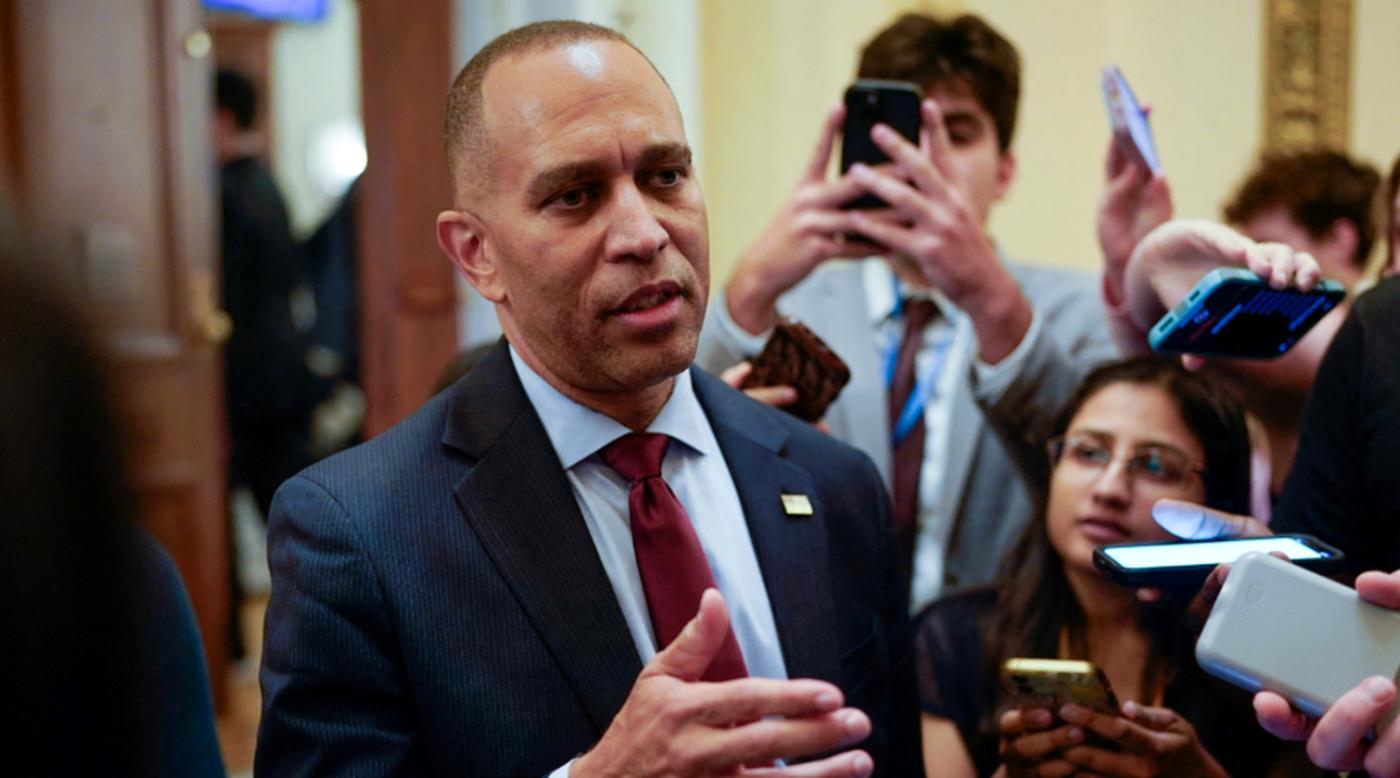
House Democratic Leader Hakeem Jeffries is facing mounting criticism following the Virginia Supreme Court’s decision to strike down the state’s newly approved congressional map, with Republicans accusing Democrats of overreaching in a high-stakes redistricting battle that ultimately collapsed in court.
The controversy intensified after conservatives resurfaced comments Jeffries made while defending the now-invalidated maps, which Democrats believed could have delivered a major advantage in the battle for control of the U.S. House. In a 4-3 ruling earlier this month, the Virginia Supreme Court invalidated the voter-approved congressional map, finding that Democratic lawmakers violated procedural requirements under the state constitution when placing the referendum on the ballot.
The decision marked a major setback in the broader national redistricting war unfolding between Republican and Democratic-controlled states ahead of the midterms.
Before the ruling, Jeffries had strongly defended the effort and argued that Democrats were on solid legal footing. “The law is with us in Virginia,” Jeffries previously said while promoting the redistricting plan.
The ruling forced Virginia to redraw its congressional districts ahead of the 2026 midterm elections and erased what Democrats hoped would become a 10-1 advantage in the state’s congressional delegation
Following the ruling, Jeffries issued a fiery statement accusing the Virginia Supreme Court of disenfranchising voters and undermining democracy.
“Over three million Virginia citizens cast their votes in a free and fair election, yet the State Supreme Court has chosen to invalidate their voice, disenfranchise them and violate their due process rights,” Jeffries said.
“The decision to overturn an entire election is an unprecedented and undemocratic action that cannot stand,” he added.
That statement quickly came back to haunt Democrats after the state’s highest court sided with Republican challengers and blocked the maps from taking effect
Supreme Court of weakening the Voting Rights Act and enabling what he described as attacks on minority representation across the South.
“We are exploring all options to overturn this shocking decision,” Jeffries said. “No matter what it takes, House Democrats will win in November so we can help rescue this nation from the extremism being unleashed by Donald Trump and Republicans.”
CNN does a flashback to Hakeem Jeffries talking big on Virginia redistricting, saying “The law is with us."
— Western Lensman (@WesternLensman) May 8, 2026
…then delivers the reality check. Brutal. pic.twitter.com/8mlBBKPKNW
Virginia Republicans and conservative commentators noted that GOP lawmakers had pushed for earlier judicial review of the referendum process before votes were cast, warning that constitutional problems could derail the maps. Democrats proceeded anyway, betting the maps would survive legal scrutiny.
Jeffries also tied the ruling to broader Democratic attacks on the judiciary, accusing “far-right extremists” on the U.S
The court ultimately ruled otherwise.
The failed Virginia effort became one of the most expensive and politically consequential redistricting fights in the country. Reports estimate Democrats and aligned outside groups spent roughly $70 million backing the referendum campaign and associated political efforts before the maps were invalidated. The ruling also exposed growing internal divisions among Democrats over redistricting strategy.
Some Democrats argue aggressive map-drawing is necessary to counter Republican-controlled states that have redrawn congressional boundaries to strengthen GOP advantages. Others privately questioned whether Virginia Democrats ignored obvious legal vulnerabilities in pursuit of a short-term political gain.
Republicans immediately seized on the remarks, arguing Democrats were lashing out after an aggressive redistricting strategy failed in court
According to recent projections, Republicans could gain significant new congressional advantages through revised maps in states including Texas, Florida, Ohio, Missouri, Tennessee, and North Carolina. Democrats, meanwhile, have pursued redistricting gains in states such as California and Utah.
Republicans currently believe they could net as many as 14 additional House seats through ongoing redistricting efforts, while Democrats project possible gains of six seats from their own map changes.
The fallout continues to reverberate through Democratic circles as party leaders debate how aggressively to pursue redistricting fights moving forward, especially with control of the House expected to hinge on only a handful of seats in 2026.