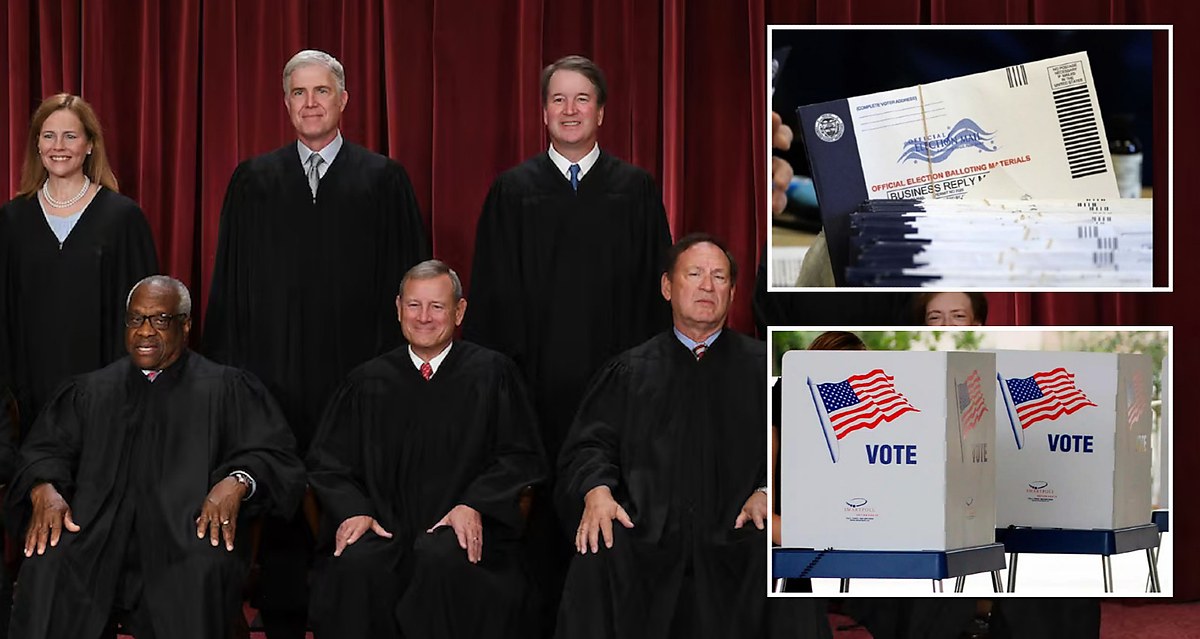
A late election fight has produced an intervention from the Supreme Court,
with immediate consequences for identification rules. At issue is how far federal judges should go when voting approaches and state officials are already implementing election procedures. The Supreme Court allowed New Hampshire to enforce guidance excluding student IDs as evidence of voter identity Thursday. The order delivers a victory to state officials and Republicans who
supported their request for emergency relief. Justice Ketanji Brown Jackson dissented, challenging the majority’s application of the principle against judicial changes close to elections. The case, Scanlan v. Coalition for Open Democracy, involves Secretary of State David Scanlan and a dispute over identification guidance. New Hampshire’s legislature passed HB 323 this year, removing student identification
cards from the list of expressly accepted voting IDs. But the litigation reached beyond whether those cards could independently satisfy the state’s identification requirements. It concerned whether election officials could consider them alongside other evidence through an alternative identity-verification process. That distinction became central after Scanlan issued guidance treating student cards as unavailable for establishing
identity under that process. A federal district court left the underlying statutory restriction standing while ordering changes to the state’s guidance.
The Supreme Court stayed the district court’s October 2 and October 5
preliminary injunction orders. The justices relied on the principle associated with Purcell v. Gonzalez, which cautions against federal intervention shortly before elections. The majority said the district court had identified nothing sufficient to justify departing from that principle here. The ruling allows state officials to continue their approach while the litigation proceeds through the appeals
process. For Republicans defending identification safeguards, the result preserves enforcement during the final stretch before the November election. The Republican National Committee supported New Hampshire’s position, according to the Associated Press. State Representative Donald McFarlane, the bill’s sponsor, welcomed the decision as a win for consistent identification standards. “Today’s Supreme Court decision is a victory
for common sense,” McFarlane said in a statement reported by the Associated Press. He argued that colleges lack the same controls used by government agencies when issuing identification cards. Jackson viewed the lower court’s intervention differently, arguing it addressed misleading explanations of existing law. In her account, the district judge required accurate public information while
leaving the state’s election rule untouched. She reasoned that correcting inaccurate guidance could reduce confusion, serving the very purpose underlying Purcell.
The disagreement therefore involved both election timing and the characterization of what
the lower court had ordered. The district court examined a statutory provision permitting other evidence that reasonably establishes a prospective voter’s identity. That provision supplied the basis for considering student cards within a broader assessment, rather than treating them as automatically sufficient. The lower court found the state’s categorical guidance inconsistent with the remaining alternative
verification provisions. Its analysis distinguished removal from an approved list from exclusion as evidence in every relevant circumstance. The state challenged the resulting injunction, bringing the timing question before the Supreme Court less than two weeks before voting. Thursday’s intervention resolves which orders control immediately, while leaving the broader legal dispute subject to further proceedings.
The stay remains tied to the First Circuit appeal and any timely request for Supreme Court review. If the Supreme Court declines that later review, its order provides that the stay terminates automatically. If review is granted, the stay continues until the Court sends down its judgment. Those conditions underscore that emergency relief and a
final decision on the merits perform different functions.
The immediate enforcement victory does not amount to a comprehensive national ruling
about student identification in every state. Nor does the order establish that students are ineligible to vote simply because they attend college, The Associated Press reported. The dispute concerns evidence used to verify identity, a narrower question than eligibility across the entire student population.